
2026 Physical Therapy Predictions: The Year We Find Out What We're Made Of
Part I of II

Every year I make predictions about our great profession. Every mid-year I grade them. Every December I either take a victory lap or explain why I was “directionally correct” (translation: wrong, but not embarrassingly so).
Last year went pretty well. Medicare Patient Choice Act: A. AI documentation adoption: A-. GLP-1 MSK impacts: A. Clinician shortage: A. The profession validated my pessimism and my optimism in roughly equal measure.
But 2026 feels different.
Not worse, necessarily. Just... more consequential. The decisions practices make this year—about pricing, positioning, technology, and capital—will compound. The margin for “we’ll figure it out later” is shrinking.
Here’s what I see coming:
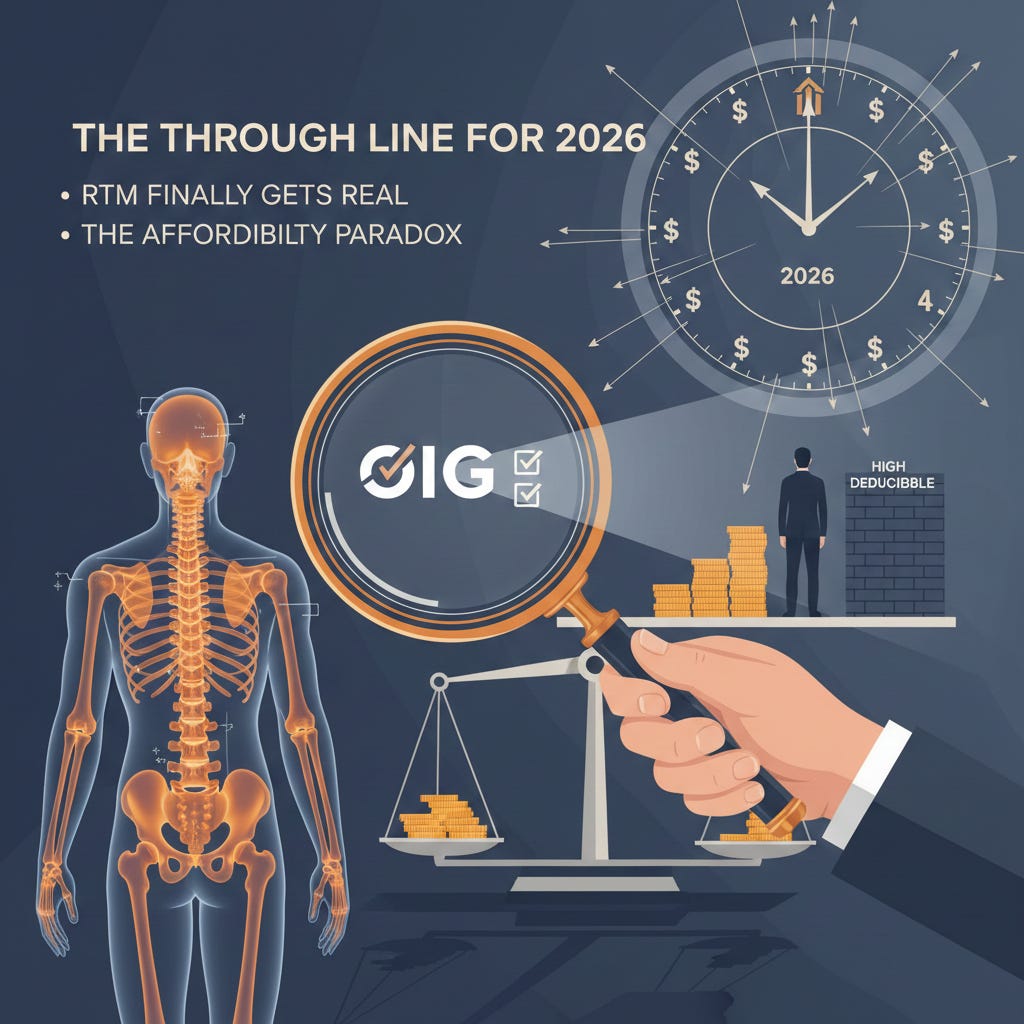
The Throughline for 2026
The physical therapy profession is caught between unprecedented clinical demand and unprecedented barriers to converting that demand into visits.
We won the argument that PT should be first-line treatment for MSK pain. Patients can’t afford to take the advice. Employers are routing them to digital alternatives. PE-backed platforms are managing debt loads instead of growth strategies. CMS is simultaneously making new revenue streams easier to access and harder to bill correctly. And now, Medicare is piloting AI-powered prior authorization that—if it “works”—will eventually come for us too.
It’s a lot. Let’s break it down.
The Five Predictions
1. RTM Finally Gets Real — CMS made the codes workable, but compliance chaos will separate legitimate platforms from “billing modules with a dream.” Someone’s getting audited.
2. The Affordability Paradox — The steepest insurance cost increases in 15 years will suppress PT utilization even as demand spikes. We built the evidence base. Patients can’t afford to use it.
3. The DIY Revolution — YouTube PTs with 5 million subscribers and $3 billion digital MSK platforms aren’t coming for our patients. They already have them. The referral funnel is leaking from the top.
4. PE in Physical Therapy — The year the spreadsheet wins. Dealmaking shifts from growth narratives to balance sheet survival. Boring becomes a business strategy.
5. The Algorithm Will See You Now — AI-powered utilization management is coming for healthcare. PT isn’t on the initial target list—but we’ve seen this movie before in Medicare Advantage. We know how it ends.
None of these exist in isolation. The affordability crisis pushes patients toward DIY alternatives. DIY alternatives validate themselves with research we helped produce. PE platforms struggling with debt can’t invest in the differentiation that might win patients back. RTM could help practices capture revenue for work they’re already doing—if they don’t get tripped up by compliance complexity. And looming over all of it: an algorithmic gatekeeping infrastructure being built right now that will eventually decide whether patients can access any of this care at all.
It’s all connected. And it all lands in 2026.
In Part 1, we’ll cover Predictions 1 and 2. Part 2 tackles the rest—plus what I’m watching and have even created some scales for grading.
Let’s get into it.
Prediction 1: RTM Finally Gets Real—But The Compliance Chaos Is Just Beginning
The Prediction: Remote Therapeutic Monitoring adoption will triple among outpatient PT practices in 2026—and so will OIG scrutiny. The gap between “we added RTM codes” and “we have a defensible RTM program” will become painfully clear. At least one major enforcement action or high-profile audit finding will hit the PT space, triggering a wave of vendor consolidation and practice panic. By December 2026, RTM will be a genuine revenue stream for sophisticated practices and a compliance liability for everyone else.
The Setup: Let’s be honest: RTM has been a mess.
CMS created the codes. CMS said PTs could bill them. CMS then provided guidance so vague that “compliant” became a matter of interpretation, vendor marketing, and crossed fingers. For years, practices have been caught between “this could be significant revenue” and “this could be significant exposure.”
The 2024 fee schedule changes helped. The elimination of the originating site requirement expanded possibilities. The 16-day minimum monitoring threshold gave practices clearer parameters. But here’s the thing about clearer parameters: they also make non-compliance easier to identify.
The Math: At current rates, a practice seeing 200 patients monthly could generate $40,000–$80,000 in annual RTM revenue for work they’re arguably already doing—patient check-ins, home exercise monitoring, outcomes tracking. That’s real money. That’s “hire another PTA” money. That’s “actually invest in technology” money (yep I do get that payors need to pay for it but we at least now have precedence).
But only if it’s billed correctly. And only if the documentation supports it. And only if the patient consent process is airtight. And only if the monitoring is genuinely clinical and not just “we texted them asking how they feel.”
The Irony: The practices most likely to benefit from RTM—those already providing high-touch, outcomes-focused care—are often the least likely to have the administrative infrastructure to bill it correctly. Meanwhile, the vendors most aggressively marketing “turnkey RTM solutions” are often the ones cutting corners that will eventually attract auditor attention.
CMS created a revenue opportunity. The OIG will eventually clarify the boundaries. The question is how many practices end up on the wrong side of that clarification.
The Vendor Problem: Here’s what keeps me up at night about RTM: the vendor ecosystem.
Some vendors have built legitimate platforms—actual monitoring capabilities, documentation workflows, compliance frameworks, clinical integration. They’re expensive. They’re complicated. They require practice workflow changes.
Other vendors have built... billing modules with a dream. They’ll get you the codes. They’ll generate the claims. What they won’t do is build the documentation trail that survives a records request.
In 2026, the difference between these two categories will become very, very clear. And practices that chose based on “lowest cost” or “easiest implementation” may discover they bought a liability, not an asset.
Sub-Predictions:
1a. OIG will issue PT-specific RTM guidance or initiate targeted enforcement. They’ve been watching. The telehealth/remote monitoring space is a stated enforcement priority. PT practices billing $50K+ annually in RTM codes are building target profiles. It’s not a matter of if, but when—and 2026 is the year.
1b. At least two major RTM vendors will exit the market or be acquired. The vendors who built compliance shortcuts instead of compliance frameworks will face a choice: invest heavily in infrastructure or get out. Some will choose the exit. Others will get absorbed by larger players cleaning up market share.
1c. Practice RTM adoption will reach 15–20% penetration, up from roughly 5%. The revenue opportunity is too significant to ignore. But adoption will be bifurcated: sophisticated practices with genuine programs, and everyone else adding codes without understanding the exposure.
1d. Average RTM revenue per adopting practice will decline as utilization broadens. Early adopters were high-volume practices with complex patient populations. As adoption spreads to smaller and more generalist practices, the per-practice revenue opportunity will compress. The gold rush phase is ending.
1e. APTA will issue substantially more detailed RTM guidance, likely in response to enforcement activity. They’ve been cautious. They’ll stop being cautious when members start getting audit letters.
1f. By Q4 2026, “RTM compliance audit” will be a standard due diligence item in practice acquisitions. PE buyers have learned expensive lessons about acquiring billing liabilities. RTM programs will get the same scrutiny that coding practices and documentation systems already receive.
The Bottom Line: RTM is real. The revenue is real. The compliance risk is also real.
The practices that will win in 2026 are the ones treating RTM like a clinical program that happens to generate revenue—not a billing code that requires clinical justification. They’re documenting every patient interaction. They’re building workflows that would survive a records request. They’re choosing vendors based on compliance infrastructure, not implementation speed.
The practices that will struggle are the ones who heard “new revenue stream” and stopped listening at the compliance requirements. They’re about to find out that CMS giveth and OIG taketh away.
We’ve been given an opportunity to get paid for work we’re already doing. Let’s not screw it up.
Prediction 2: The Affordability Paradox—Rising Costs Will Suppress PT Utilization Despite Record Demand
The Prediction: Outpatient physical therapy visit volume growth will decelerate to 2.5%–4.0% in 2026, down from the 5–9% growth we’ve seen over the past three years—despite unprecedented clinical demand. The steepest health insurance cost increases in 15 years will collide with an American public already stretched thin, creating a utilization ceiling that no amount of workforce expansion or clinical need can overcome.
Because nothing says “patient-centered care” like a $2,600 deductible.
The Setup: The last few years have been genuinely good for outpatient PT volume. The public company disclosures show meaningful rises in visits and per clinic per day volumes. The overall U.S. PT services market grew from $44.8 billion in 2022 to $47.6 billion in 2024.
Post-COVID pent-up demand, aging boomers, the opioid-alternative narrative, and operational improvements drove this surge. We staffed up. We got more productive. Patients showed up.
But 2026 brings a different cost environment.
Mercer’s 2025 National Survey projects total health benefit cost per employee rising 6.5%—the highest since 2010. Without employer cost-cutting measures, it would be 9%. Crucially, 59% of employers plan to make cost-cutting changes to their health plans in 2026, up from 44% in 2024.
Translation: employees will see paycheck deductions rise 6–7% and face higher deductibles and copays on top of that.
The average deductible for single coverage already hit $1,886 in 2025. Workers at small firms face $2,631 on average. More than half of employees at small firms now have deductibles exceeding $2,000. Medicare’s Part B deductible climbs to $283 in 2026—up $26 from 2025.
The Research: We have strong evidence on what happens when patients face higher cost-sharing: they skip PT.
A 2023 study in the American Journal of Preventive Medicine found that high-deductible health plan enrollment was associated with a 1.2 percentage point reduction in the probability of receiving any chronic pain treatment—driven specifically by reductions in nonpharmacologic treatment use.
That’s us. Physical therapy is “nonpharmacologic treatment.”
The same study found patients with lower cost-sharing were more likely to receive PT than those with higher cost-sharing. When PT costs $50–$75 per visit out-of-pocket and you need 10–15 visits, that’s $500–$1,000 before insurance kicks in. People delay. People drop off. People choose the $15 copay for a prescription instead.
Rheumatologists have documented this pattern for years: decreased utilization at the beginning of the year when deductibles haven’t been met, followed by a year-end rush. That’s the Q1 slump and Q4 surge we’ve all noticed in our own clinics—and it’s about to get worse.
The Paradox: Clinical demand for PT has never been stronger.
APTA’s 2025 workforce study documented a 12,000+ FTE PT shortfall nationally, with 72% of practices operating at or over capacity. Forty-one million Americans have used GLP-1 drugs, and up to 40% of their weight loss is lean muscle mass—creating a tidal wave of sarcopenia and fall-risk patients. Boomers are aging. MSK conditions are spiking. Nearly one in three Americans have an MSK disorder, the leading cause of disability in the U.S.
We should be drowning in patients. In many ways, we are.
But financial access is tightening just as clinical need accelerates.
The Uncomfortable Truth: The average American would rather take ibuprofen and hope for the best than pay $75 out-of-pocket to see us. That’s not a reimbursement problem. That’s a perception problem. That’s a value communication problem. And it’s about to become an existential problem for practices that can’t adapt.
We built an evidence base. We got the guidelines updated. We convinced physicians that PT should be first-line treatment. And now patients can’t afford to take their advice.
Make it make sense.
Sub-Predictions:
2a. Q1 2026 will see the sharpest year-over-year growth deceleration as deductible resets collide with higher thresholds than ever. January–March will feel noticeably softer than prior years. “I’m feeling better” will become code for “I can’t afford another copay.”
2b. Visits per episode of care will decline slightly as patients self-ration. They’ll drop off at visit 6 instead of completing 12. Research already shows self-discharge rates around 55% for patients with chronic pain—expect this to tick upward.
2c. Payer mix will shift toward Medicare. Seniors will continue showing up (they need PT and have lower cost-sharing concerns post-deductible). Commercial utilization will soften, especially among younger, healthier patients in HDHPs who decide their back pain “isn’t that bad.”
2d. Cash-based and hybrid practices will outperform traditional insurance-dependent models. When insurance feels like a bad deal—high premiums, high deductibles, prior auth headaches—transparent pricing becomes attractive. Practices offering cash-pay options will capture patients fed up with the insurance experience.
2e. The profession will finally start discussing affordability as an access barrier—not just reimbursement rates. If patients can’t afford their copays, the reimbursement rate is irrelevant. This is a policy issue, a practice design issue, and a communication issue—all at once.
The Bottom Line: Physical therapy has never been more needed. But in 2026, it may become harder for patients to access—not because of provider shortages or coverage gaps, but because of the cumulative weight of premiums, deductibles, and copays that make even covered care feel unaffordable.
The practices that figure out how to make PT financially accessible—through transparent pricing, payment plans, HSA education, or creative benefit design—will thrive. The rest will wonder why schedules softened in a market with a 12,000-PT shortage.
We won the clinical argument. We’re losing the economic one.
Coming in Part 2
That’s the foundation: a new revenue opportunity wrapped in compliance risk, and a utilization environment about to get harder despite record demand.
But we’re not done.
In Part 2, we’ll cover:
Prediction 3: The DIY Revolution — Bob and Brad have 5 million YouTube subscribers. That’s more people than live in Ireland. And they’re telling those people they can probably treat themselves. Here’s what that means for your referral pipeline.
Prediction 4: PE in Physical Therapy — The refinancing wall is real. 2026 is the year the spreadsheet wins. What that means for deals, valuations, and the practices trying to get bought.
Prediction 5: The Algorithm Will See You Now — CMS just launched AI-powered prior authorization in Original Medicare. PT isn’t on the target list—yet. But we’ve seen what Medicare Advantage insurers did with these tools. The denial machine is getting faster, cheaper, and less human.
Plus: What I’m Watching in 2026 (specific signals I’ll track to grade these predictions) and The Punchline (what all of this means for how you run your practice).
Stay tuned.
larry
@physicaltherapy
What am I missing so far? Predictions 1 and 2 feel right to you? Hit reply or drop a comment—I want to pressure-test these before the year actually starts.
And hey, if you’re enjoying this breakdown, consider subscribing to All Things #Physicaltherapy and sharing with colleagues who need to see this.
So many of these issues collide to create revenue decline and individual clinic decline.
It’s true there is opportunity in crisis! The PT industry seems to be in constant crisis mode.
Time to rally.
Would love to start with a strong RTM program. Anyone out there actually making money from RTM in a general practice? We have tried and asked lots of clinic owners I have not run across the secret sauce yet.
What worrisome isn’t any single item on the list but rather how well they all work together to hide the continued structural decline.
Boomer demand keeps schedules full.
RTM turns friction into revenue.
Algorithms quietly absorb authority upstream.
DIY captures first contact.
PE optimizes what’s left.
Nothing “breaks” it just hollows out further.
The danger of 2026 is accommodation will feel rational, even successful.
RTM will buy time. Boomer volume will mask the continued loss of leverage. PTs will have a rally cry with a little revenue.
Further erosion of professional authority disguised as disruption.