
The Weekly Tactical Is Supposed to Run the Platform. Yours Probably Doesn’t
Part III of a series on the meetings that actually run a healthcare platform — and the ones that just look like they do.

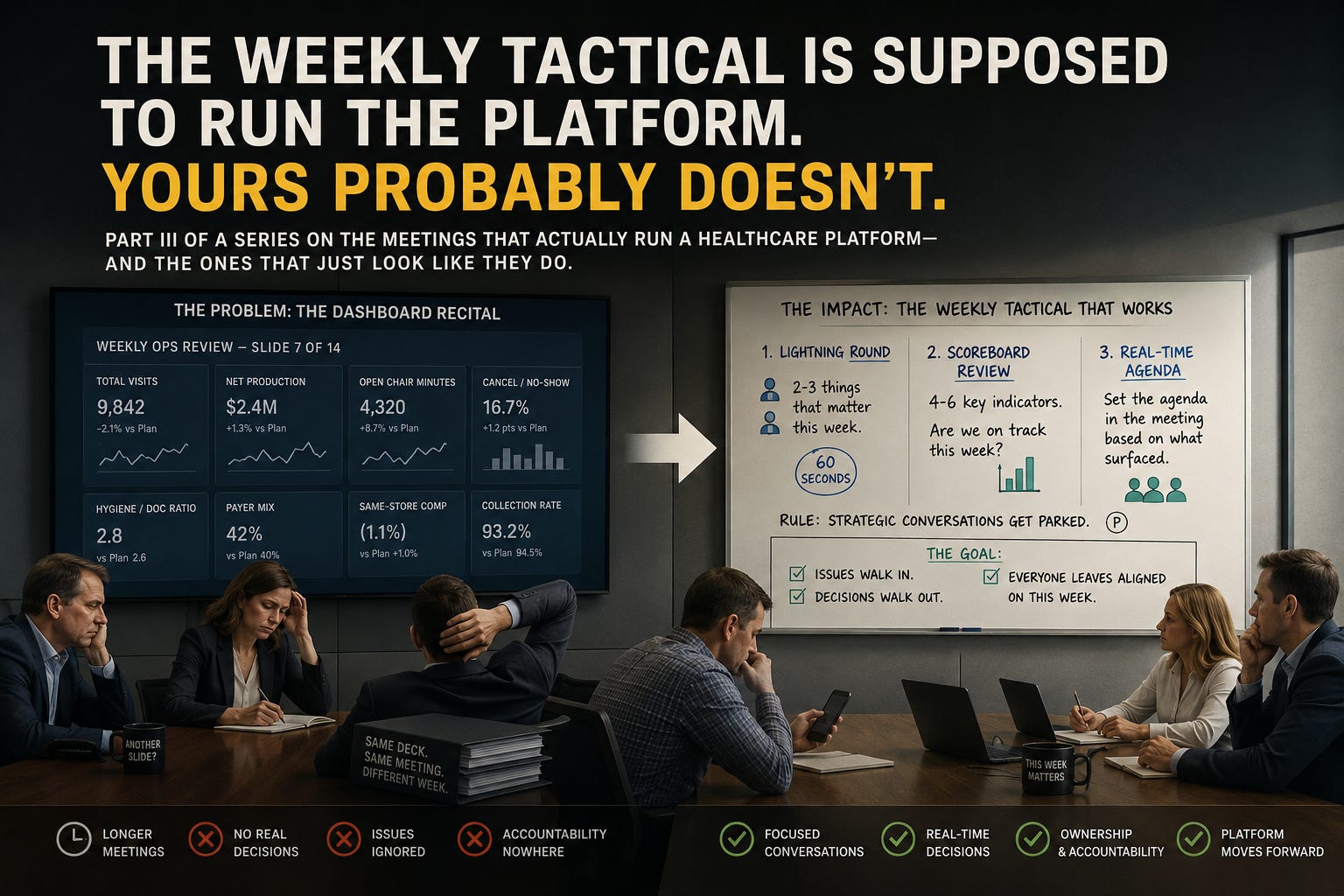
It is Tuesday at 10:00 AM. Six people are in a conference room at HQ. Four others are on the wall screen — two regional VPs from their cars between site visits, the CFO from a home office, and the head of clinical from an airport.
The COO opens the laptop in front of him, says good morning, and pulls up the weekly ops deck.
Fourteen slides.
Same fourteen slides as last week.
He walks through slide one — total visits versus plan. Slide two — net production by region. Slide three — open chair minutes. Slide four — cancel and no-show rates. By slide seven, the regional VP on the airport tile has muted to take a call. By slide nine, one of the in-room regionals is checking his phone under the table. By slide eleven, the head of clinical has dropped off entirely and rejoined, which somehow counts as participation.
At minute sixty, someone raises a real issue — a payer denial pattern that is going to cost the East market $400,000 this quarter if nobody acts.
The COO says, let’s follow up offline.
The regional VP nods.
Nobody follows up offline.
The meeting ends at 11:32. Nothing has been decided. The same fourteen slides will be presented again next Tuesday. The payer denial will still be there. The platform will be ninety minutes closer to its end-of-quarter board meeting and not one inch closer to fixing the thing that is going to embarrass it on the call.
That meeting is on every leadership team’s calendar somewhere. In most multi-site healthcare platforms, it is the most important meeting in the operating cadence. Patrick Lencioni said so explicitly.
He was right.
It is also, in most platforms, the worst meeting on the calendar.
I want to start where I started with the huddle — by being clear about what this meeting is supposed to do, because the phrase weekly ops review has been stretched so far that it now means almost nothing.
The weekly tactical, in Lencioni’s Death by Meeting framework, is a 45- to 90-minute leadership team meeting whose entire job is the execution of this week.
Not strategy.
Not the board agenda.
Not last month’s results.
This week.
The meeting has three parts and one rule.
The first part is the lightning round. Each leader gets about 60 seconds to share the two or three things that matter most this week. Not a performance review. Not a TED Talk. Not a weather report from the South Region. Sixty seconds.
The second part is the scoreboard review. Four to six key indicators. Not thirty. Not every tab in the workbook. Not a tour of the dashboard so everyone can admire the fact that the dashboard successfully loaded. A handful of numbers that tell the team whether the platform is on track this week.
The third part is the part almost nobody actually does: the real-time agenda.
The agenda for the rest of the meeting is set in the meeting, after the lightning round and the scoreboard review, based on what actually surfaced. Not before. Not from a pre-baked deck. Not because someone in finance spent Monday afternoon making the same slides look slightly more blue.
Lencioni calls this disciplined spontaneity, which sounds like something consultants would say right before billing you for a workshop, but in this case it is exactly right. The discipline is the structure. The spontaneity is admitting that you cannot know on Friday afternoon what next Tuesday’s leadership meeting actually needs to solve.
The one rule is that strategic conversations get parked.
If the topic needs more than ninety minutes of thinking — network design, capacity modeling, payer strategy, acquisition integration, clinical labor redesign — it does not belong inside the weekly tactical. It gets named, logged, and scheduled as a strategic conversation. Strategic and tactical issues often look alike when they first enter the room. They require different meetings.
The goals are simple:
Issues walk in.
Decisions walk out.
Everyone leaves with the same understanding of what this week is about, what changed, who owns what, and what will be different by the next meeting.
If that did not happen, the meeting failed. It does not matter how thorough the deck was.
That is the weekly tactical.
Now let me describe what it has become in most healthcare platforms.
The Dashboard Recital
The most common failure mode is the Dashboard Recital.
The meeting opens with a pre-built deck — sometimes fourteen slides, sometimes thirty, sometimes a document so large it should have its own compliance officer — that walks through the same fixed set of trailing metrics, region by region, week after week.
Total visits.
Net production.
Same-store comp.
Cancel and no-show rates.
Hygiene-to-doctor ratio.
Payer mix.
Open chair minutes.
Each leader takes a turn confirming that their slice of the dashboard is, in fact, displaying correctly.
This is not a meeting.
It is a slide read-through.
A thirty-slide deck is not an agenda. It is a sedative with page numbers.
The problem is not that the numbers are irrelevant. The numbers matter. But they are not the meeting. They are inputs to the meeting. In a functioning operating cadence, the trailing dashboard gets sent in advance and read in advance, ideally by adults who can be trusted to open a PDF without supervision.
The weekly tactical is not where the team discovers what happened last week. It is where the team decides what to do this week.
The Dashboard Recital reverses that. It converts the most important execution meeting in the company into a retrospective tour of things the team can no longer change.
The payer denial spike is already happening. The clinician requisitions are already aging. The region that is about to miss plan has already started missing plan. The weekly tactical is supposed to ask: what now?
Instead, the platform spends ninety minutes looking backward and then leaves the room to run the week on instinct, Slack, and whoever happens to text the COO first.
The Defensive Round-Robin
The second failure mode is the Defensive Round-Robin.
This is what happens when the lightning round becomes a weekly courtroom appearance.
Each leader gets sixty seconds, in theory. In practice, each leader uses the time to pre-defend their numbers.
I know production was down 4% in the South Region last week, but here is why, and here is what we are doing, and the next three weeks already look better, and two providers were out, and one site had a water issue, and if you normalize for chair availability and the moon phase, the number is actually not as bad as it looks.
Sixty seconds becomes three minutes.
Three minutes becomes seven.
The lightning round becomes the meeting.
This failure mode is especially common in healthcare platforms because regional leaders often experience the weekly ops meeting as the place where they are visibly evaluated by the COO in front of their peers. They are not stupid. They prepare accordingly.
They explain.
They contextualize.
They preempt.
They bring receipts.
They say things like, I just want to give some context on those numbers.
That phrase is the smoke alarm.
When someone says, I just want to give some context on those numbers during a lightning round, the lightning round is dead. Whatever follows may be useful. It may even be true. But it is not what the lightning round is for.
The lightning round exists to surface the handful of live issues that require the room. It is not a regional performance defense. It is not group therapy for last week’s variance. It is not a chance for every leader to demonstrate that they, too, have been very busy.
The prompt should not be:
“What happened in your region last week?”
The prompt should be:
“What is the one thing this week that you cannot fix without this room?”
That one change alters the meeting.
It moves the conversation from explanation to execution.
The “Follow Up Offline” Cemetery
The third failure mode is the most expensive.
It happens when an actual issue finally surfaces.
A payer denial pattern.
A labor gap.
A clinician productivity problem.
A referral source issue.
A site-level operational risk that someone has finally been brave enough to name in front of the group.
And the response from the COO, or whoever is running the meeting, is the same four words every time:
Let’s follow up offline.
Sometimes the phrase is well-intentioned. The leader knows the topic needs more time than the room can give it. In a healthy operating cadence, that is fine. The issue gets logged. An owner gets assigned. A follow-up gets scheduled before anyone leaves the room. The team knows where the issue went.
In an unhealthy cadence — which is most of them — let’s follow up offline is not a process.
It is a cemetery.
The issue gets buried with full honors.
No owner.
No date.
No next step.
No record.
Everyone nods solemnly and moves on to slide twelve.
The meeting ends. The COO has thirteen other things on the calendar. The regional VP who raised the issue gets pulled into a staffing problem. The CFO sends a different spreadsheet. The head of clinical is now boarding group three.
The issue is not actively dropped. That would imply a level of intention the system does not possess.
It is just never picked up again.
By Thursday, nobody remembers it specifically enough to revisit it. By the following Tuesday, when the Dashboard Recital returns for its weekly residency, the issue has either gotten worse on its own or resolved itself in the least controlled way possible.
I have watched this pattern play out in three separate platforms. A real operating issue gets raised in the weekly tactical, gets sent offline, disappears, resurfaces three weeks later as a board-level problem, and then becomes a multi-week recovery exercise consuming five times the leadership attention that a twenty-minute decision in the original meeting would have required.
The cost of let’s follow up offline in a multi-site platform is staggering.
It is also entirely invisible in any operating report.
The fix is mechanical and boring, which is probably why nobody does it.
Someone in the room has to write down every commitment.
Owner.
Action.
Date.
Then the meeting cannot end until the commitments are read back.
That is not bureaucracy. That is the minimum viable operating system for adults who claim to be running a company.
The hybrid two-track makes all of this worse
The Dashboard Recital, the Defensive Round-Robin, and the Cemetery all existed before 2020.
Hybrid work did not create them.
It did, however, give them a new and quietly destructive failure mode.
In the hybrid two-track meeting, the people in the room form the real meeting. The people on the screen form the witness gallery.
The in-room participants make eye contact. They catch the COO’s body language. They trade small asides before and after the formal discussion. They know when the conversation is actually over, not just when it is officially over.
The remote leaders watch the room watch itself.
This matters because the weekly tactical is not a broadcast. It is a decision meeting. And in a decision meeting, airtime is power.
The regional VP calling in from her car between site visits gets less airtime than the regional VP sitting three chairs from the COO. Her issues get less time. Her pushback gets less weight. Her follow up offline requests get parked harder.
Over three months of this, she learns the rule.
The room is the meeting.
The screen is the audience.
Workplace research has been naming this problem for years now as proximity bias, and anyone who has sat through a hybrid executive meeting does not need much convincing. Owl Labs found that 54% of employees are more likely to consult colleagues they physically work with than their remote peers, and Microsoft research has found that 43% of remote employees and 44% of hybrid employees report they do not feel included in meetings. The people physically near power tend to receive more attention, more informal context, and more benefit of the doubt. The technology does not eliminate the hierarchy. It usually makes the hierarchy harder to see and easier to deny.
In a healthcare platform, this is not a minor meeting-design problem. Regionals are already distributed. Site visits already pull leaders into cars, airports, clinics, and home offices. If the weekly tactical is the meeting that runs the platform, and half the platform experiences it as a livestream of the real conversation, the cadence is broken before the first slide appears.
The fix is simple and widely ignored.
Either run the meeting fully in person, or run it remote-first.
Everyone in the same room, or everyone individually on their own laptop.
Same plane.
Same chat.
Same visual field.
Same rules.
The mixed-mode meeting is the worst configuration because it pretends to be inclusive while structurally privileging the people who happened to be near the coffee.
If the meeting matters enough to run, it matters enough to design.
The decision count test
There is a clean test for whether your weekly tactical is doing the work.
Take last week’s meeting.
Count the number of decisions that walked out of the room that were not already made when the meeting started.
Not topics discussed.
Not issues raised.
Not updates shared.
Not “alignment.”
Decisions.
Meaning:
We are going to do X.
Owned by Y.
By Z date.
And next week we will know whether it happened.
In a healthy weekly tactical, that number is usually somewhere between three and eight.
In most multi-site healthcare platform weekly ops reviews I have seen, the honest number is zero.
Sometimes one, if we are being generous and counting “send the updated file” as a decision, which we should not, but by that point everyone is tired.
If your decision count is zero or one week after week, the meeting is broken.
It does not matter how comprehensive the deck is.
It does not matter how senior the people in the room are.
It does not matter that the meeting starts on time, ends close to on time, and has a recurring invite with a polished agenda.
The meeting is performing the visual ritual of operating without producing any of the artifacts of operating.
A platform does not run on updates.
It runs on decisions, commitments, and follow-through.
The weekly tactical is where those are supposed to happen.
What a real weekly tactical actually requires
The fix is not exotic. It does not require software. It does not require a new transformation office. It does not require a laminated meeting charter, although someone will eventually make one.
It requires five decisions.
First, a real lightning round.
Sixty seconds per leader. Enforced by the COO. The prompt is not, what happened last week? The prompt is, what is the one thing this week you cannot fix without this room?
That question changes the meeting because it forces the room to become useful.
Second, a scoreboard with four to six leading indicators.
Not thirty trailing metrics. Not the board deck. Not the entire operating report dragged into a conference room and read aloud like scripture.
Four to six numbers that tell the team what is starting to happen before it becomes unrecoverable.
Capacity utilization variance.
Clinician requisitions trending the wrong way.
Payer denial spikes by market.
New patient demand softness.
Referral source leakage.
Whatever actually predicts the next operating problem in your business.
The trailing dashboard belongs in the pre-read. If the leadership team cannot be trusted to read the pre-read, the problem is not the meeting format.
Third, a real-time agenda.
No pre-baked slide march.
No tour of the dashboard.
The agenda gets built in the room from what the lightning round and scoreboard surfaced.
This will feel uncomfortable the first few times because people who are used to hiding inside decks suddenly have to participate in a meeting.
That discomfort is information.
Fourth, a strict parking rule.
Strategic topics get named, logged, and parked. If they cannot wait until the monthly strategic meeting, an ad hoc strategic session gets scheduled before anyone leaves the room.
Follow up offline without an owner and a date is no longer an acceptable sentence.
It is allowed only if the next words are:
“Owned by Sarah. Thirty minutes tomorrow. Decision due Friday.”
Otherwise it goes to the cemetery, and everyone knows it.
Fifth, a visible commitment record.
Someone writes down every decision and every commitment.
Owner.
Action.
Date.
At the end of the meeting, the commitments are read back.
At the beginning of the next meeting, they are reviewed.
This is not complicated. It is just rare.
If your leadership team did those five things and nothing else this quarter, the platform would tighten within sixty days. The meetings would get shorter. The issues would get clearer. The amount of performative updating would fall. The number of actual decisions would rise.
None of this requires a consultant.
All of it requires a COO willing to admit that the meeting currently called the weekly tactical may not actually be one.
Next in the series
Next week: the monthly strategic — the meeting that is supposed to be where the platform’s hardest questions get debated, and that in most healthcare platforms has been quietly converted into a slide deck parade where decisions arrive pre-baked.
We will talk about why writing the memo matters, why Bezos was right about narrative documents, and what a strategic conversation looks like in a multi-site platform when it is actually working.
For now, one thing to try this Tuesday.
When you sit down at the weekly ops review, do not bring the deck.
Open the meeting with the lightning round.
Sixty seconds per person.
The prompt is:
What is the one thing this week you cannot fix without this room?
Then set the agenda from what surfaces.
The first time you do this, the meeting will feel uncomfortable and slightly chaotic.
Good.
That discomfort is the meeting starting to do its job.
larry
Thanks for reading The Operator. If this one made you uncomfortable, good — that means it’s working. Subscribe for free to receive the rest of the series, and forward it to the COO whose Tuesday morning meeting has fourteen slides, ninety minutes blocked, and zero decisions on the table. Content reflects Larry’s personal views and opinions, not the official positions of any affiliated organization.
Operator = meeting architect